The enameling dies to use high-quality natural diamonds, polycrystalline and tungsten carbide as raw materials, and the unique inlay process ensures the out-of-roundness of each mold and the inlay position of the mold core, the inner hole tolerance is precise, the finish is good, and there is no paint leakage.
The advantages of Enameling dies
The enameling die has perfect contour and leak-proof design to ensure uniform coating, smooth and continuous flow of enameled, and high insulation performance of wires.
The paint layer on the wire surface is uniform, and the tolerance is precise.
It is widely equipped with various domestic or imported enameling machines.
High wire insulation performance.
Two Assembly Methods for Enameling Dies
Normal Assembly vs. Integral Assembly
Enameling dies are key components that control the uniformity and dimensional accuracy of the enamel coating during the wire enameling process. The assembly method directly determines the service life of the die, the quality of the enamel coating, and production stability.
In industrial applications, normal assembly and integral assembly are the two mainstream assembly schemes. They differ significantly in processing logic, structural features, advantages and disadvantages, as well as application scenarios, which are explained in detail below.
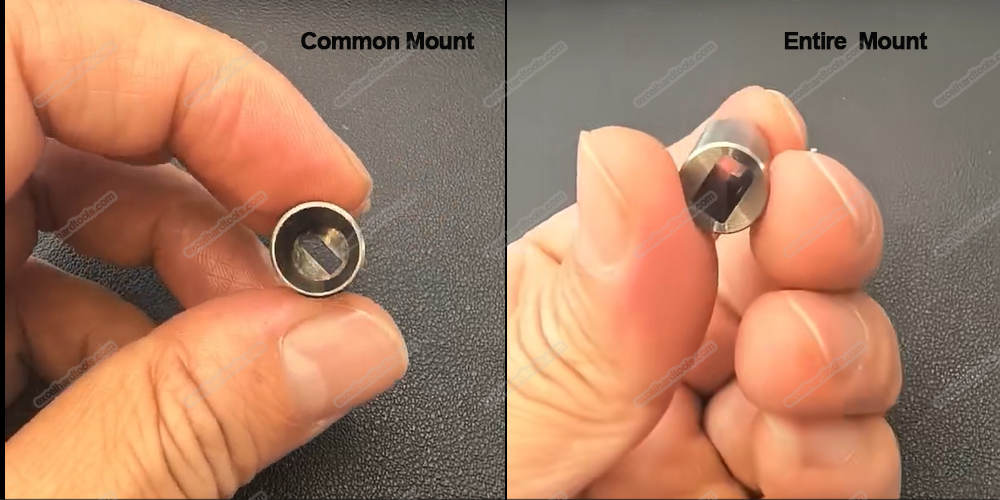
1. Normal Assembly
Core Processing Logic
Normal assembly is the most basic method for enameling dies. Its core process is:
First machine the inner hole on the carbide / PCD insert, then assemble the insert into the steel case.
1. High-quality cemented carbide is selected as the insert material, and the inner hole (including diameter, taper, surface roughness, and other parameters) is precisely machined to meet the requirements of the enameling process.
2. The inner hole of the matching steel case is machined according to the outer diameter of the carbide insert to ensure proper fitting accuracy.
3. The finished carbide insert is assembled into the steel case by means of shrink fitting or press fitting to complete the enameling die.
Structural Features
• The carbide / PCD insert and steel case adopt a split structure; the insert is processed independently and the case is formed separately.
• The inner hole parameters of the insert are fully finalized before assembly, so the assembly process does not affect the hole accuracy.
Advantages
• High processing flexibility; the carbide insert can be adjusted individually to suit different enameling conditions.
• Low maintenance cost; the worn insert can be replaced separately without discarding the entire die.
• Low processing difficulty and high yield rate.
Disadvantages
• Dependent on assembly accuracy; gaps or insert loosening may occur, affecting coating uniformity.
• Possible slight displacement between insert and case after long-term use, reducing stability.
• Requires professional tooling for assembly.
Typical Applications
• Small-batch, multi-specification production of enameling dies.
• Production lines requiring frequent parameter adjustments.
• Dies with complex inner hole structures.
2. Integral Assembly
Core Processing Logic
Integral assembly is the preferred method for high-precision enameling dies. Its core process is:
First assemble the carbide/PCD insert into the steel case, then machine the inner hole as a whole unit.
1. The outer diameter of the carbide insert is pre-machined to ensure a tight fit with the steel case.
2. The insert is assembled and fixed firmly into the steel case to form an integrated structure.
3. The inner hole is precision machined by grinding or honing on the assembled unit to ensure high dimensional accuracy, concentricity, and surface finish.
Structural Features
• The carbide /PCD insert and steel case form an integral, rigid structure with no relative movement.
• Inner hole accuracy is guaranteed by final overall machining, with minimal assembly deviation.
Advantages
• Extremely high precision and concentricity, ensuring stable and uniform enamel coating.
• Excellent structural stability; no insert loosening during long-term production.
• High strength, suitable for high-speed and continuous enameling lines.
Disadvantages
• Higher processing cost and stricter requirements for equipment and operators.
• Poor maintainability; the entire die must be replaced when worn.
• Low flexibility for process adjustments.
Typical Applications
• Mass production requiring high consistency.
• High-precision enameling processes.
• Long-term, high-stability continuous production lines.
3. Comparison Table
Item | Normal Assembly | Integral Assembly |
Process | Machine insert first, then assemble | Assemble first, then machine the hole as a whole |
Structure | Split type | Integrated type |
Accuracy | Medium, depends on fitting accuracy | High, guaranteed by integral machining |
Maintenance Cost | Low, insert replaceable | High, entire die replaced |
Flexibility | High | Low |
Typical Application | Small batches, frequent changes | Mass production, high precision |
4. Selection Guide
• Normal Assembly is recommended for small-batch customized production, frequent process adjustments, and cost-sensitive scenarios.
• Integral Assembly is more suitable for mass production, high-precision requirements, and long-term stable operation.
The two methods each have their own advantages. The optimal choice depends on your production scale, enameling requirements, and cost budget.

 Sandra